Our Story Sacred Calendar Pilgrimages Pricing FAQ Gift a Subscription Contact Submit Details Now
← Back to RadhaKrishna.io

Our Story

Why RadhaKrishna.io
Exists

Most of us don't lack the desire to remember God. We lack the conditions for it.

That distinction matters. Because when spiritual life keeps slipping out of our hands, we tend to blame ourselves: I don't have enough discipline. I don't know enough. I should pray more. I should read the Gita. I should teach my children more.

But look at the life we're actually trying to practice Bhakti inside.

1. No time — especially for ourselves.

Work doesn't stop pressing on you. Bills, deadlines, commutes, messages, responsibilities. By the time evening arrives, you don't necessarily want enlightenment — you want to switch off. And even that switching-off rarely includes you. The day empties out long before you ever get a turn on your own list — not from a lack of love. From habit.

2. The attention economy — and its new disease.

"Brain rot" was Oxford's Word of the Year for 2024 — the slow dulling of the mind from too much low-quality content. "Doomscrolling" joined it soon after — the thumb that won't stop moving, long after the mind has stopped learning anything new. We get exactly what we want, instantly, again and again — a notification, a laugh, a small jolt of outrage — and that's precisely the trap. Somewhere in that loop, serotonin and dopamine are being pulled like strings, and most of us don't even notice the hand pulling them. Even when you want to sit quietly with something sacred, another part of the mind has already been trained to ask: what's next?

3. Na yahan ka, na wahan ka.

Neither fully here, nor fully there. Our children are growing between worlds — inheriting another civilization, another set of stories, while rightly feeling at home elsewhere. Research on second-generation immigrant youth — including the work of psychologist John W. Berry — has found that young people who stay involved with both their heritage culture and the wider culture around them tend to adapt better than those who stay connected to neither. Our job isn't to pull our children backward. It's to make sure something precious can still travel forward with them.

4. Loneliness — gazetted, and ungazetted.

The World Health Organization's 2025 Commission on Social Connection reported that roughly one in six people worldwide experience loneliness. That's the gazetted count — official enough to be surveyed, tabulated, published. Guess, then, about the ungazetted: the loneliness that never fills out a form, that sits through a family dinner and calls itself fine. RadhaKrishna.io is not a treatment for that. But Bhakti introduces another dimension to relationship — the possibility of living with the Divine not merely as an idea, but as a presence.
What We're Truly
Up Against

Step back far enough, and these aren't really five separate problems. They're symptoms of the same deeper shift.

Devotion lost its environment.

A grandmother told you a story before bed. Someone was doing puja in the next room. Nobody called it "habit formation" — it was simply life. Then families became smaller, we migrated, and we started asking one overwhelmed person to recreate through discipline what a whole community once created naturally.

And time lost its sacred rhythm.

Ekādaśī, Janmāṣṭamī, Kārtik, fasting days, feast days — the calendar itself used to remind you that today wasn't just another day. That's why the sacred calendar isn't a side feature here. Maybe what's missing isn't better time management. Maybe it's time meaning something again.

How I Chose
to Build This

For most of my life, faith didn't come easily to me. I wanted to believe — I wanted Bhakti, devotion, a real relationship with God or a Guru — but I never found the roadmap. I'd try, drift away, try again. For almost four decades, it remained somewhere just beyond my reach.

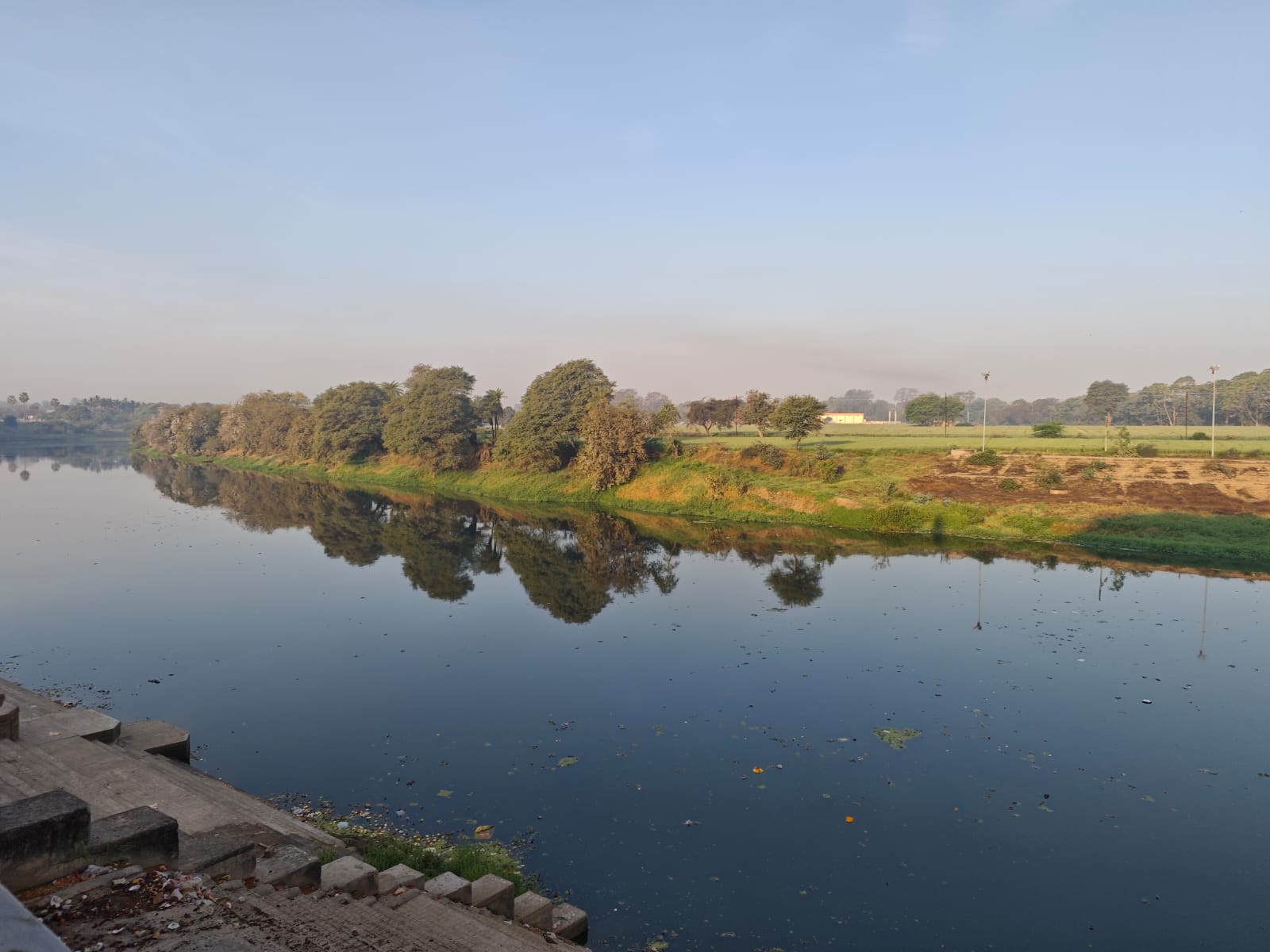
Then something changed. During a visit to the ancient Mangalnath Mandir in Ujjain, on the banks of the Shipra River, I went for a puja. Something happened there — a moment of divine presence I still can't fully put into words, and don't feel I need to. It was deep. It was intensely personal. And it changed the direction of my life.

Photograph coming soon — Mangalnath Mandir, Ujjain, on the banks of the Shipra River

In the months that followed, a spiritual teacher came into my life and graced my life — and there was a kind of sunshine deep inside I had never known before. I didn't set out to build it. Like a seed that had quietly taken root without my knowing, it was now pushing toward the light on its own, and it has only kept growing since.

Then, one day on the balcony of the apartment where I was living in Mississauga, another episode happened — I experienced something I can only describe as an out-of-body experience, accompanied by a clarity I had never known before.

Photograph coming soon — the Mississauga apartment balcony, 32nd floor, where this happened

Out of that clarity came an idea. What if the roadmap I had searched for didn't have to begin with something enormous? What if it began with five minutes?

I sat down and built RadhaKrishna.io in a single stretch — about fifteen hours — because for the first time, I finally understood exactly what I wanted to create. Not a course. Not another obligation. Not an app making you feel guilty because you're seven lessons behind. Not an infinite feed designed to keep you scrolling.

Just: one story. One verse. One small practice. Five minutes with Radha and Kṛṣṇa. And tomorrow, another five.

You don't have to wait for a moment like mine. You don't need to wait until you're a certain age, and you don't need a miracle. You don't need to become knowledgeable enough, disciplined enough, pure enough or spiritual enough before you're allowed to begin. Begin first.

Life is full of crossroads, and most people pass through them without ever knowing that one of the roads was Bhakti. I found that road later than I wish I had. And I can tell you, with everything I have, that this is one of the most beautiful roads you will ever walk.

I won't pretend the road became clear once I stepped onto it. If anything, it's the opposite — the deeper I walk, the less I find I can explain. It's full of mystery, layered in secrets, and I've stopped treating that as a problem to solve.

A line from Mirabai, a Kabir doha that says one thing and clearly means another — these still move through me the way morning moves through a tea garden in Assam: thick with mist, alive with something I can sense long before I can name it, clearing a little more each time I walk back in, never all at once. I don't think that was ever meant to be handed over whole. I think it was always meant to be walked into, again and again, on its own timing, not mine.

It's a little like going out at dawn in Kaziranga hoping to see a tiger. You don't summon it. You go back, and back again, through the same tall grass, the same early mornings — most of them giving you nothing at all — until, without warning, one morning gives you everything. It costs you the returning, every time, with no promise attached. That cost isn't a flaw in how this works. It's the whole design. And that, more than anything else, is what I'm actually offering you here — not the mystery solved, just the discipline of showing up at the tree line one more morning, in case today is the day something moves in the grass.

And I'll admit something else plainly, because this whole project only makes sense if I do. I didn't build this only to give something away. I built it also because I am still looking — the way you might be — for a circle with a deeper sense of belonging, responsibility, and intimacy. A few people who've walked far enough into the same fog to recognize what I'm pointing at without my needing to explain it fully. A satsang, in the oldest sense of the word: not an audience, a company. Somewhere I can bring what I still don't understand, and be met there — not corrected, not taught, just met.

All my life I wanted a roadmap. I wanted devotion. I wanted Bhakti to grow within me. Now that I've embarked on this journey myself, I want to leave a small lamp beside it for whoever comes next.

What If Five Minutes a Day
Could Change the Rhythm of Your Life?

We won't tell you Bhakti will fix this or cure that. We don't want to make promises we can't keep. Spiritual life isn't a transaction.

But here's what we can tell you: it works quietly. You don't fight your way out of an old habit or an old grudge. One day you simply notice you haven't thought about it in a long time — that it's just... gone. The hate you carried for someone insignificant, the jealousy, the need for revenge — your mind isn't there anymore. It's shifted, on its own, toward something else.

That's what it means to have God walking beside you, growing within you. He doesn't ask you to let go. You just find, one day, that your hands are already empty.

There may even be a quieter shift still, one we hesitate to name too soon. A thought arrives that doesn't quite feel self-made. A choice feels less like something you decided and more like something you were led to. We don't claim to fully understand this, and we're careful not to overclaim it. But we've noticed it — and we suspect the longer someone walks this road, the more familiar that feeling becomes.

So don't promise yourself a year. Don't promise yourself transformation. Just begin with today. Read today's story. Carry one thought with you. Chant His name once, then again. And tomorrow, if you remember, come back. If you forget, the door will still be here.