ॐ
Read Before You Join
These are two real editions of the Daily Offering, exactly as they arrived in a subscriber's inbox — unedited, unpolished for this page. A third, on Rādhā alone, is coming soon.
Daily Bhakti · Day 1
The eternal meeting — two souls who recognized each other as one.
It was autumn in Vrindavan, and the night smelled of jasmine. The moon had risen full over the Yamuna, and Krishna had lifted His flute — one note, and every gopi in every house felt her heart step outside her body and walk toward the forest. They left their milk unchurned, their bangles half-fastened, their husbands and mothers-in-law calling after them into the dark. Nothing in the world was louder than that flute.
They danced with Him for what felt like a single unbroken moment and also for a lifetime — the Rasa, where Krishna multiplied Himself so that every gopi felt certain, absolutely certain, that He danced with her and no one else. That is the nature of His love: it does not divide when it is shared. It simply grows to meet however many hearts arrive.
But at some point in the dancing, Krishna vanished.
One gopi noticed first that His hand had slipped from her hand. She turned, and He was gone — not beside her, not in the circle, not anywhere the moonlight reached. The music went on without Him for a moment before the other gopis noticed too, and then the whole clearing fell quiet and searching, the way a room falls quiet when someone realizes the one person they came for has already left.
They searched the riverbank. They searched the groves, calling His names into the dark — Govinda, Madhava, Shyam — as if the right name, said with enough love, might be the one that brought Him back. And in their searching, they found something: footprints in the soft earth, pressed fresh, walking away from the others, toward a deeper part of the forest. But they were not alone. Beside Krishna's footprints, matching His stride exactly, was a second pair — smaller, quieter, walking so close to His that in places the two sets of prints seemed to merge into one.
The gopis stood over those footprints for a long moment, and understanding arrived the way dawn arrives — not all at once, but as something that had clearly been coming the whole time. Of everyone who loved Him in that forest that night, He had risen from the dance and, without a word to the rest, taken only her hand. He had wanted to be nowhere else.
They were not angry. If anything, they felt something closer to awe — the particular ache of watching someone you love be loved perfectly by someone else, and finding you cannot begrudge it, because it is simply, unmistakably right. One of them said what all of them were already thinking: this gopi alone must have worshipped Him so completely, so without holding anything back for herself, that even the Lord of all the worlds could not help but love her in return, above every other soul in Vrindavan.
The scripture does not say her name here. It never does, not directly — the sage who narrates these verses is said to have kept it hidden out of reverence, the way one might keep the dearest name in one's life close to the chest rather than say it lightly. But the word used to describe her — ārādhitā, "the one who has perfectly worshipped" — carries the name inside it anyway, the way a seed carries the whole tree. Say ārādhitā aloud a few times, slowly, and you will hear it: Rādhā. It was always there, hiding in plain sound, waiting for someone to listen closely enough to find it.
That is how her name enters the greatest scripture on Krishna's pastimes — not announced, not proclaimed, but discovered, the way love itself is so often discovered: quietly, in the space between two sets of footprints walking closer together than anyone else's ever had.
अनया राधितो नूनं भगवान् हरिरीश्वरः ।
यन्नो विहाय गोविन्दः प्रीतो यामनयद्रहः ॥ २८ ॥
anayā rādhito nūnaṁ bhagavān harir īśvaraḥ
yan no vihāya govindaḥ prīto yām anayad rahaḥ
This gopi alone, the verse says, must have worshipped the Supreme Lord Govinda most perfectly — for He was pleased enough with her, above every other gopi present, to leave them all behind and walk with her into a quiet, secluded place.
Śrīmad-Bhāgavatam 10.30.28 · Rāsa-pañcādhyāyī
Relevance in Current Times
True love recognizes. It doesn't chase. We live in a world that teaches us to pursue — to prove ourselves worthy, to earn love through effort and performance. Radha's story teaches something quieter: the deepest love isn't won through chasing. It is recognized. It simply knows, and is known in return.
Naam Jaap Reminder
Your beads are waiting. What's the count on your ring counter? Have you chanted today?
Daily Bhakti · Day 2
Devotion is measured by love, not by what you can afford to give.
There was a brahmin in a small village who owned almost nothing. His clothes were patched more than they were whole. His children went to bed hungry more nights than they didn't. He had studied at the same gurukula, under the same teacher, as a boy he once called his dearest friend — a boy who was now, by every report reaching even this poor village, a king. Ruler of Dvaraka. Husband to queens. Krishna Himself.
For years, the brahmin never once considered going to him. Not out of pride exactly — more a kind of quiet resignation, the sort that convinces a person their old friendships belong to a life they no longer live. But his wife saw her children's hollow cheeks and could not bear it any longer. "Go," she told him. "He was your friend before he was anyone's king. Surely he remembers you. Take him something, at least, so you don't arrive empty-handed."
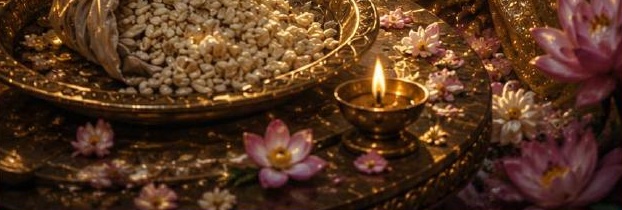
There was nothing in the house worth bringing. So she went to the neighbors and begged — four handfuls of flattened rice, the plainest food there was, the kind poor people ate because it cost almost nothing and lasted long. She tied it into a small knot of torn cloth. He held it the whole way to Dvaraka, growing more ashamed of it with every step. What was he thinking, arriving at a king's palace with a beggar's fistful of rice?
He almost turned back at the gate. But then Krishna saw him.
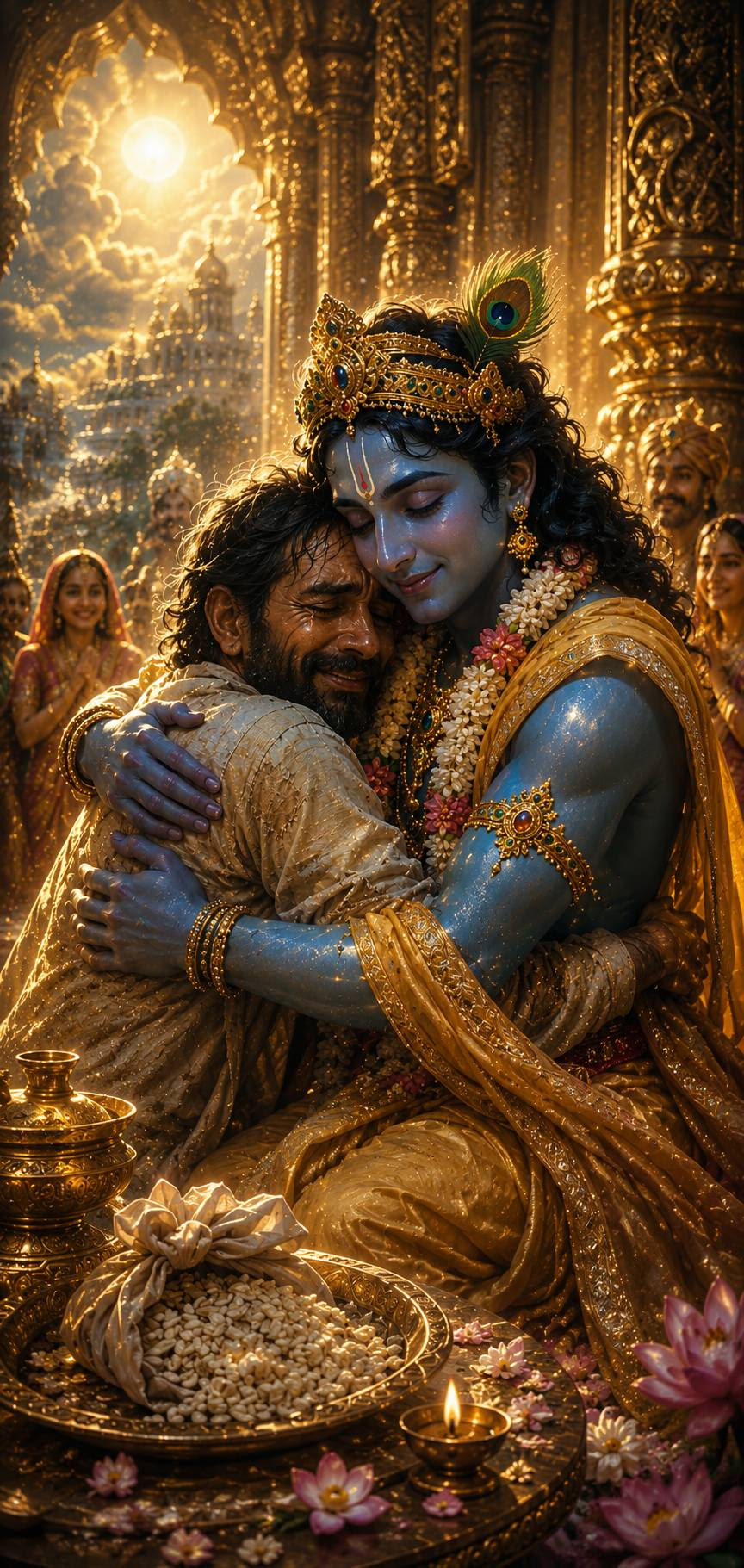
The king of Dvaraka — seated on a bed fit for royalty, surrounded by wealth beyond counting — rose so fast His crown nearly slipped, crossed the hall in a run, and threw both arms around the poor brahmin before a single word had passed between them. He held him the way you hold someone you thought you might never see again. He washed his friend's feet with His own hands, the hands of the Supreme Lord of all creation, and would not let anyone else near him — not a servant, not a queen — because this reunion, He seemed to say without saying it, belonged to no one but the two of them.
Devotion is measured by love, not by what you can afford to give.
The brahmin stood frozen through all of it, too overwhelmed to speak, the little cloth bundle of rice hidden behind his back. He could not bring himself to offer it. What was flattened rice, beside all this? He would rather Krishna never see it at all than watch Him look at something so small and so obviously poor.
But Krishna already knew. He always knows. He reached behind His old friend's back, took the bundle from his hands before he could stop Him, opened the torn cloth Himself, and ate the flattened rice as if it were the richest meal ever placed before Him — one handful, then reaching for a second, His queen beside Him watching in wonder as the Lord of all opulence closed His eyes in something like relief, as if He had been waiting His whole reign for exactly this and nothing else.
The brahmin left the next morning without asking for anything. He had come to see his friend, not to beg — that was the whole and only truth of it, and it was enough. He walked the long road home turning it over and over: how strange, how impossibly strange, that the poorest gift of his life had been received like the finest one Krishna had ever been given.
It was only when he reached the place where his hut should have stood that he understood he had never needed to ask. Where there had been a single crumbling room, there now stood a house of shining pillars, gardens heavy with lotus blooms, servants moving through rooms of a kind he had never even imagined standing inside. His wife came out to meet him dressed like a queen, and behind her, his children — not hungry, not one of them, not anymore.
He did not celebrate. He sat down, quietly, and prayed instead that he would not lose, in all this sudden abundance, the very thing that had brought it to him — a devotion that had never once, in all his years of poverty, asked Krishna for anything at all.
क्वाहं दरिद्रः पापीयान् क्व कृष्णः श्रीनिकेतनः ।
ब्रह्मबन्धुरिति स्माहं बाहुभ्यां परिरम्भितः ॥
kvāhaṁ daridraḥ pāpīyān kva kṛṣṇaḥ śrī-niketanaḥ
brahma-bandhur iti smāhaṁ bāhubhyāṁ parirambhitaḥ
These are Sudama's own astonished words, spoken to himself in the middle of his overwhelm: "Who am I? A poor man, hardly worth calling a brahmin at all. And who is Krishna? The Supreme Lord, overflowing with every opulence there is. And yet — He embraced me with both arms."
Śrīmad-Bhāgavatam 10.80–81 · Sudāma-caritra
Relevance in Current Times
Devotion is measured by love, not by what you can afford to give. We live in a world that quietly ranks generosity by size — the bigger gift, the better giver. Sudama's rice says otherwise. What moved Krishna wasn't the value of what was offered. It was that His friend had walked the whole way there with nothing but love and a fistful of rice, and hadn't let the smallness of it stop him from coming at all.
Naam Jaap Reminder
Sudama brought Krishna a fistful of rice — all he had. One round of the name today is what you can bring: a gift you give your own heart.
A third morning — on Rādhā alone, before Kṛṣṇa ever entered the frame — is coming soon.
If This Is What Mornings Could Feel Like
Free, always. No card needed. Delivered before your world begins.